I nostalgically remember our recent stepping into the new century, 2, maybe 3 years ago…
I was up in the attic, in my comfortable office, the skylight letting in the light that was pleasantly engulfing my table filled with files, and the desk. I liked the desk – its pastel colours reminded me of the childhood cup of hot frothy cocoa. I also liked the silence it was immersed in late at night, when I would linger way after the hours were done, caught up in solving who knows what matter.
More than 20 years have passed since, but the image of me sitting behind that desk is more vivid than ever: I can see the shirt barely covering my belly, the coffee run cold in the mug – my not so guilty pleasure – and the cash flow forecast in A3 format spread across the coffee table.
I was barely a little over 30 and had recently celebrated my first 10 years as an entrepreneur. I had started overeating really and had a messy lifestyle, triggered by the huge stress and the overwhelming workload exceeding 12 hours a day. To boot, my haircut was that of a preschooler and was also full-figured, proportionally with the success I had been enjoying in the previous years. My metabolism must have started to slow down, seeing as all my life I had been skinny as a pole. Of course, my figure had been maintained with the help of my communism-characteristic lifestyle, when my mother and I shared food so that a bloody chicken would last us a whole week.
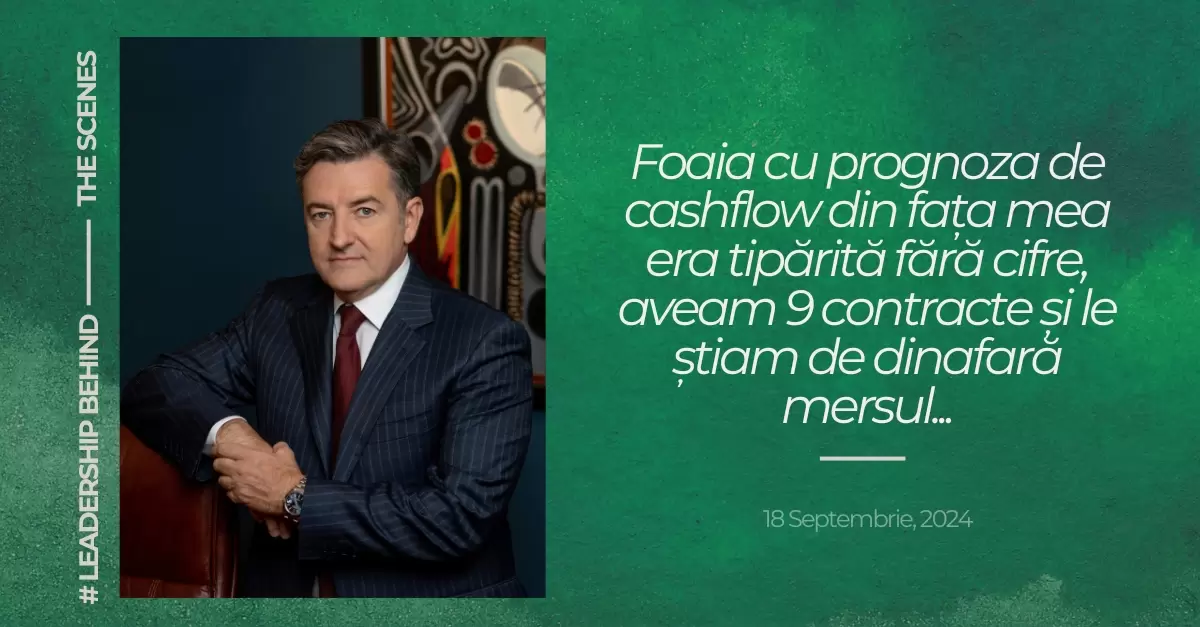
The printed sheet of the cashflow forecast didn’t include any figures, I had 9 contracts rolling and I knew how they were going by heart. It was quiet, everybody had left, and I had just ended a discussion with the most important team member who told me he could no longer work for the company because of the uncertainty. He had a small child to raise…
I felt for him, I wished him success in all his endeavours, and I uncomplainingly turned back to my papers, avoiding thinking about what I was going to do next. I kept standing there, looking through the skylight, for a few more minutes.
Daylight saving time brought about longer light hours, as if doing its best to make the figures pertaining to the 9 contracts add up. I had erased all recently added sums. They didn’t add up at all …
Again, I started erasing and calculating using my 1 mm mechanical pencil (my college-inherited habit), while at the same time mumbling: contracts will issue … outputs to suppliers… salaries, other expenditures… What other expenditures!? No other expenditures! Minus -this huge, definite minus in the lower right side… This is not good!
This is what most afternoons and evenings even looked like at the time. It wasn’t easy at all.
I had truly been successful during the first 10 years, and quite reasonably so, but nothing out of the ordinary. My brother and I could afford two second-hand brand cars, we had our own flats in communist but nice buildings, and in good neighbourhoods. His on Barbu Văcărescu boulevard, mine on Matei Voievod… it wasn’t bad.
It was the time of the economic crisis then though. We had started building equipment for the degassing of transformer oil and an office hall in Otopeni. It was then that the crisis hit. It put rust on the blade for both us and many other entrepreneurs – lack of financing by banks at the time, which did not understand entrepreneurship, the recovering shaky economy resulting from the disaster of the 1995-2000 period, and an irrational hike of the currency exchange rate that nobody had foreseen. Classic!
For the first time in my life, I couldn’t see a way out. I wasn’t even thinking then that I would find myself in the same situation again two more times.
However, nights spent at the office bore fruit and we managed to see the light from this crisis: we successfully built the (office) hall and we sold it right away, actually doubling our investment. We cut our expenses, reconsidered our development plans and successfully met all our contractual obligations. And it’s what we did time and again after that.
I often get the chance to be a speaker at conferences and tell the story of what it is to be an entrepreneur. There are 1,600 of us across the country today, we have a group in Switzerland which sells complex systems for the global metallurgy industry, and I feel appreciated and, I dare say, perhaps even envied.
Many times, I feel like talking about how difficult it’s been, how much it all cost, how much self-doubt I had to deal with and the number of times I thought I’d fail. But I feel like not everyone will deeply comprehend and then I don’t speak up. I am in constant touch with the authorities, with ministers and with various clerks and try to shut up about how much I’ve been through in order to be able to pay various taxes and levies exceeding EUR 10 million a year; they wouldn’t understand.
I often feel like shouting out to everyone, that they shouldn’t be appreciative of me, because there’s nothing to appreciate about the sleepless, anxious nights and a life lived in disarray, which the over 10 hours of work under high stress and uncertainty bring about. And I’m not thinking about me here, but about the several hundreds of thousands of small, medium and big entrepreneurs making plans, taking risks, losing, winning and adding value to our society so that it can have its hospitals, schools, a government.
It’s all these difficulties that should be at the basis of our question: “Why be an entrepreneur?”.
In the fine words of Johann Wolfgang von Goethe, “Everybody wants to be somebody; nobody wants to grow”; in other words, nobody wants to have to make the effort of growing into something great. It’s the same with entrepreneurship these days, with how it’s perceived.
I can see many businesses and companies built without an interest at the core, only based on market opportunities and short-lived motivations that are linked solely to making a profit. These are the ephemeral businesses which most of the times become insolvent on the first financial roadblock they come across because they are superficial.
I also watch a lot of interviews and podcasts of so-called mentors who often speak about “How to make a million in the shortest time” or about “All you need to know to become an entrepreneur” as if there were really a recipe for success that we could all apply and become Bill Gates overnight.
The truth is that no business or economics manual can train you for the challenges implied by being an entrepreneur. In the absence of determination and true passion for what you are doing, fast and resounding success seems impossible to me. That’s why I think that choosing to be an entrepreneur should, in most cases, be an informed choice.
There are also those who are chosen to be entrepreneurs, and not the other way around. These are the people who cannot ignore an idea or a vision, who are compelled by an inner voice to build something unique no matter the risks or the sacrifice. These are the entrepreneurs who cannot think of another way to turn their vision into reality, whether this means having to deal with failure, uncertainty or major challenges. To them, being entrepreneurs is not a choice, but a necessity in order to make their ideas come to life.
You can truly say it’s a choice and it really is so, only I don’t know which side you’re on in this choice. Is it you that chooses or are you the chosen one!?
Obviously our society can do without many things, but not without entrepreneurs, i.e., the people who bring dreams from their virtual reality and into the true world, where everybody can enjoy them.
No matter your answer, remember this.