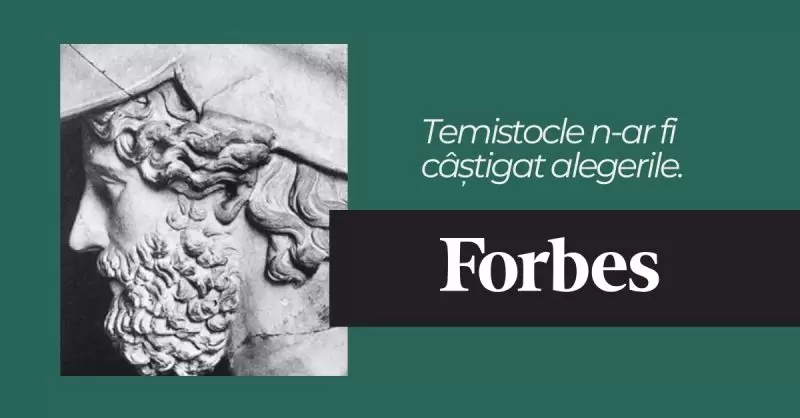
In the 5th century BC, in the newly born democracy of the city-state of Athens, an incredibly rich resource of silver was discovered. The leaders of the famous city, including the famous Themistocles, gathered excited by the potential of the discovery made in order to decide its usefulness. Of course, being in a democracy, the Athenian people and their wishes represented an important influence for the new political class. The idea that seemed to gain the most ground was that of dividing this wealth equally among the citizens of the city, who were its rightful owners. This idea seemed logical and even attractive to some politicians who wanted to be in the popular good graces. But Themistocles opposed it! He had two considerations: on the one hand, distributing such a large amount of silver to the citizens would have affected the value of this precious commodity, and on the other hand, Athens, as a fresh and prosperous democracy, saw itself exposed to the risk of attack from some island cities (Aegina), superior in naval terms, but also under the threat of a new invasion attempt by the Persians, led by a new king (Xerxes). Themistocles' proposal was to use the silver to build a war fleet.
Of course, the Persian invasion followed, with the already dramatic land battle of Thermopylae, but also the two naval battles, of which the one at Salamis would bring an unexpected victory to the Greek alliance, a victory based mainly on the new Athenian fleet built with the price of the aforementioned silver.
More than 2500 years of history still teach us lessons today.
We live in a world where – I am referring here to democracies – political leaders indulge in decisions designed to please voters, with the obvious aim of extending their mandates. Respect for the quality of opinions and their positive censorship, in the sense of qualifying them, are completely lacking. Rather, we are witnessing a competition of quantity to the detriment of quality, in terms of both subjects and decisions. The courage to tell unpleasant truths is seeping through keyholes today, and harsh reality seems like a Fata Morgana.
Democracy is representative and this assumes that those elected make decisions for the medium and long-term good of the people they represent, and not for the illusory satisfaction of a majority called THE PEOPLE.
Almost mandatory applications on phones and computers today give voice to anyone who wants to express an opinion and creates communication bubbles that pretend to be worlds with heads and tails. Majorities are formed and contribute to the viralization of ineptitudes equal in value to the level of knowledge of those who appreciate them. No such application mentions how many books the profile holder has read or in what capacity he issues opinions.
Today we write more than we read, we talk more than we listen, and we're not doing any better with thinking either.
In his latest book, Yuval Harari (Nexus) presents us with a picture of the alteration of information in historical perspective and in the context of new technologies. The moment education loses control of information flows and its qualification disappears, manipulation becomes both easy and inevitable. Inherent subjectivization takes root in any fact, and interpretations become means instead of conclusions.
The confusion we are sinking into so rapidly cannot lead to anything good, and the untruths spoken from the height of a position serve to open a space where everything is possible, there are no more limits, and nothing is certain.
The era thus created will be called the post-truth era and will be appreciated by posterity as the period in which humanity abandoned science in the arms of mystical and unknown phenomena, the trust in the arms of uncertainty, and history in the arms of conspiracy theory – it will be an era in which manipulation does not only mean distorting reality, but also creating a climate in which truth no longer matters (See the book Post-truth – Lee McIntyre).
We find ourselves today on the threshold of major decisions, pushed here by perhaps the deepest crisis since the World War II – a crisis with multiple roots, but with clear effects. The breaking of the axis of good on the alignment of the Atlantic ridge will not pass without consequences. Complex challenges will follow, but also opportunities for those who are able to see them.
It is time to be aware of our own strengths and our own values. It is time to feel, first and foremost, Europeans, custodians of the most precious cultural heritage of humanity of all time, beneficiaries of the best quality of life on this planet.
This is not the time for comfortable illusions. This is the time for realpolitik – but let us not forget that this word contains “real” and not “fabricated”. A stable world is not built with invented figures and imperial-comic attitudes. The future is not built with temporary mandates and cosmeticized truths. This is the time when we must look beyond the length of mandates and take responsibility for the unpleasant truths.
It's the time for statesmen. For those who understand that money should be spent on our safety, not on the illusion of immediate comfort. For educated adults.
We live in times where truths are rewritten overnight, and reality seems increasingly fluid, and I felt the need to check whether the world has changed so much that the meaning of European belonging has also been diluted. I felt the need to look for updated definitions.
Being European means more than geographically belonging to a continent – it is a cultural, historical and political identity. (ChatGPT)
I calmed down.
Preluare din Forbes România