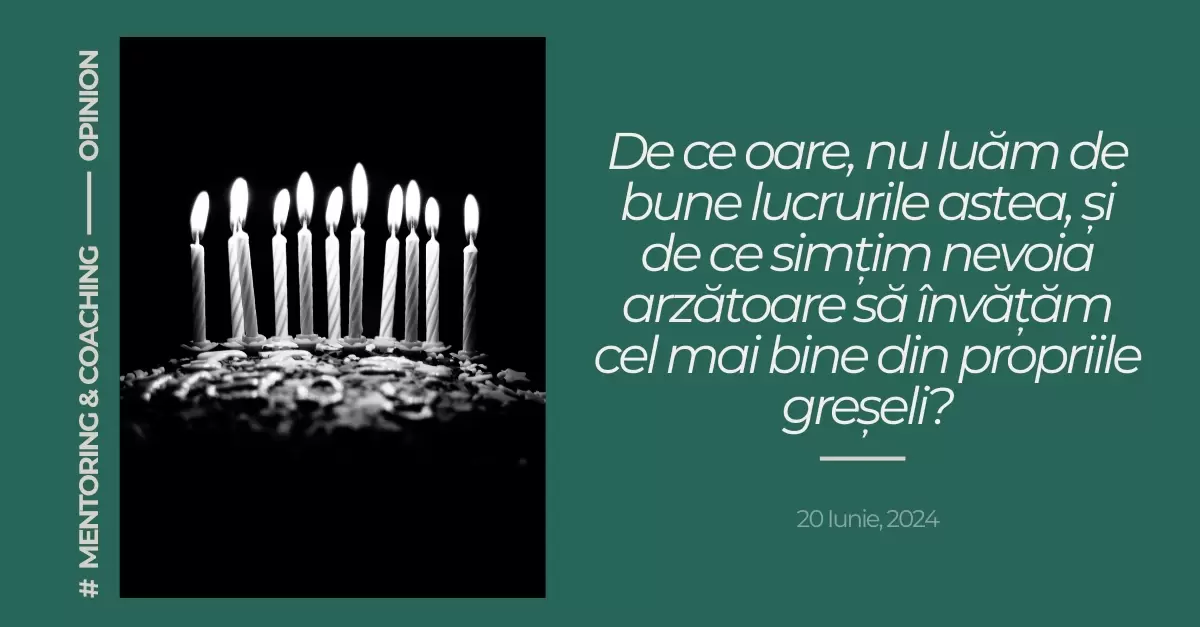
I don’t think there’s anyone who is exempted from hearing the following counsels: “What’s important is for you to avoid making mistakes”, “It doesn’t matter how deep you fall”, or at least the classical “Every kick in the ass is a step forward”. We are all familiar with them and we know how painful a blow can be, particularly the process of acceptance and recovery following making our mistakes.
I’ve been an entrepreneur for over 30 years and have lived for more than 50 years and I can say both have come with their share of defeat and pain.
This is that point in the interview where one is asked if they would change anything and where we all smilingly say no.
But the truth is that most of the time, this answer is a somatic reaction to fear. It is difficult to admit that we have doubts. It is uncomfortable and intrusive to think that, should we have acted differently, or should we have made different decisions, things would have been different, and we would have taken a different road in life.
In fact, we can’t change anything of what’s happened to us. We are aware that a certain life journey, be it personal or professional, cannot and should not lack risks or wrong decisions.
No matter how good, how cautious or strict we may be in our decision-making process, we shall obviously make our wrong decisions. Decisions matter the most, and a good life is generally built on good decisions. Which is why it is important to know the turning points in terms of decision-making in our lives, to pay them the required heed, and to learn to manage mistakes so that we do not need to make them again.
What I’ve learnt from the multitude of experiences that have drawn me into the whirlwind of life is that there are no mistakes but only lessons. Both attempts and successes, as well as mistakes are parts of the lessons we need to learn, and we best learn from our mistakes, not from the wisdom of others.
It seems paradoxical to me and there is this feeling I get, in the rare moments of peace that I find myself contemplating, that all “big” conclusions in life I manage to draw are mere reiterations of lessons we already know in theory, and it is not rarely that I feel like I am confirming some very well-known philosophical or psychological concept.
Why are we so oblivious to these things, why do we feel a burning desire to best learn from our own mistakes, to draw our own conclusions?
Intuition tells me we are doing this because we are programmed to be in search of shaping experiences to mark with profound significance and value. Mistakes are strong catalysts of our growth process.
I am 55 and I still don’t feel like I should be coming up with a book of ten commandments; what I feel like though is sharing some of the lessons I feel I have learnt:
- Take your time and trust data at least as much as you do your senses,
- Consult with a mentor, a friend - a different perspective may help you redirect,
- Learn to say no when you need to; consider yourself, your resources and your availability,
- Build up your resilience: physical, emotional, financial - it will help you in your time of doubt, which you might think you are unable to surpass,
- There are always tougher situations; be optimistic and be Tao - there is good somewhere,
- Own your mistakes and accept your limits - it’s not by accident that we learn best from mistakes and it’s also not by accident that ours are our favourite,
- Choose to accept and to understand your mistakes to be better. Do not avoid, neglect or forget your mistakes - they are valuable,
- Take the time to reflect and to analyse details, bring a more realistic friend into this process, think over what happened exactly, what you could have done differently, and what the silver lining is,
- Speak about your mistakes openly and authentically, with yourself and with others - only by being aware will you be able to better act in the future,
- Understand what was wrong and why it was so and come up with a life plan - you will discover that personal experiences are your best guide.
After all, mistakes are inherent to the learning process. Some mistakes are vital, others are minor, and what we are interested in is to move past them both. What we are not equipped with is the ability to draw as many good things from them as possible. What matters is how we approach obstacles and losses, because this is what defines us more than we would like to believe.
I am absolutely sure all those who made mistakes and those who are going to make them in the future who will remember this article will swear at me, but I do hope over the years they will see I’m right.