
The screen was running an almost endless list of everyone who had contributed in any way to the wonderful production. I, lying on the couch with a pillow under my head, was unable to tear my eyes away from the various names that were disappearing into the ground, as if they were flowing away like liquid.
As usual, my hands had gone numb from the pressure in my neck and I could feel them aching. I wanted to move, but I was stuck. Disjointed thoughts were circling in a wide loop inside my head, each trying to break free from the grip of the one next to it — to escape the absurd dance.
It had already grown dark outside on this calm Sunday. There was something about this day — a diffuse nostalgia that sifted through unanswered questions.
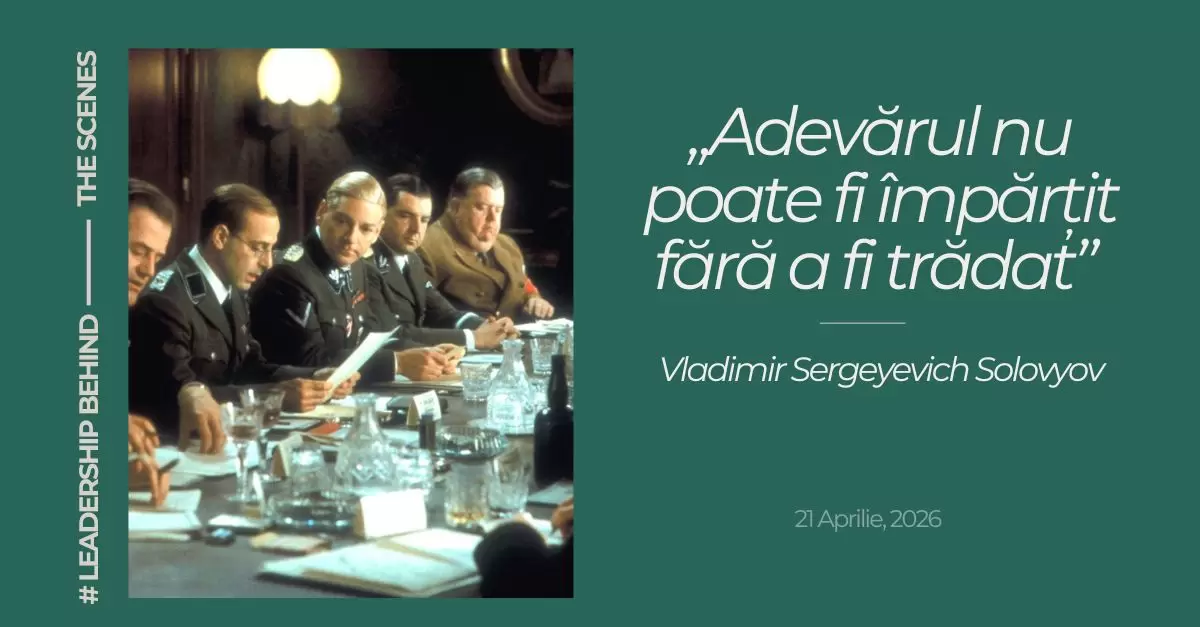
If you have seen Conspiracy, I think you would agree (as I do) that it is a film about many things, but first and foremost it felt to me like a film about how horrifying decisions are made — decisions that cannot even be spoken aloud.
For those of you who may not have seen it, it is an atypical war film that tries to reconstruct the Wannsee Conference. It is almost entirely a conversation inside a villa near Berlin, where brilliant minds discuss, in a calm, bureaucratic and technical manner, a genocide. That is, I think, what makes it so uncomfortable. It is about the embodiment of evil in leadership, about the transformation of genocide into administrative decisions, about appearance… horror.
I had already sat up, but I still cannot shake the questions that have wrapped themselves like ivy around my convictions about good and evil.
They do not bring clarity, and that hurts. They cloud things that already seemed clear, digging their roots into the grey matter of my mind.
How do you identify and stop evil in leadership? And what barriers do you place on the path to power, so that only the virtuous can pass them?
A few days have passed since watching the wonderful production directed by Frank Pierson and written by Loring Mandel, masterfully acted by, among others, Colin Firth and Stanley Tucci. The anger and negative emotions have faded, and although now clearer, my thoughts still keep raising questions.
The idea is that evil, wicked leadership is easy to detect and, although extremely harmful, it cannot really disguise itself. Sooner or later, evil is isolated and defeated by the superior power of the many who support good. This is a recurring theme in American action films, and an undeniable historical reality.
However, evil still simmers, flickers constantly somewhere in a damp cave, always ready to surface, exploiting any weakness. In between, between two very large evils and many smaller ones, there is calm — an apparently positive state, a normatively aligned and comfortable leadership context.
In the magnificent work The Antichrist by the Russian philosopher Vladimir Sergeyevich Solovyov, evil is not embodied by a Hitler (not yet born at the time of writing), but by an apparently perfect leader who advocates for good, yet under the pleasant shadow of his initiatives for peace and cooperation, fails to do what is truly relevant and refuses the deeper dimension of truth and sacrifice.
It is as if we could say that insufficient good becomes evil.
I am tempted to judge today’s leadership through this lens — both at the large political level and especially at the smaller level of business organizations. The modern leader is absorbed by normativity:
he does not lie,
he does not abuse,
he speaks of diversity in words…
But how much does he actually do what truly matters?! How willing is he to speak the truth, how willing is he to sacrifice for values?
Today, leaders talk about optimization and efficiency, about KPIs. They avoid conflict, avoid saying what is difficult to say, refuse deep truth and the dimension of sacrifice, and spend little time considering the context in which they choose to exist.
Kierkegaard would observe how deeply we have fallen into the aesthetic stage of life, where man seeks pleasure and experience, avoids boredom, and how far we have moved away from the ethical stage, where responsibility and commitment are sought and upheld.
The idea that the most serious evil is dressed in the garments of good is a shocking discovery for me. I am not looking around me — I am looking at myself, and at the hundreds of moments in which I avoided conflict when values were at stake, at the focus on efficiency, and at the haste with which I rushed toward results.
Of course, the easiest excuse is that the society we live in pushes and forces us in that direction. And so I ask you: are we good, or are we like Solovyov’s character?
Is evil in leadership perhaps one of those balls that a magician keeps spinning continuously, dazzling the audience, until here and there someone is left holding only that single ball in their hand?
Questions like these keep spinning like the magician’s balls in my mind as I walk toward the office.
It is spring, and it is time for cleaning.
I no longer want to be the leader I have been until now. I want to step out of the vortex of haste and efficiency at any cost, of frugality and lack of depth. I want to be honest enough to do what is right. I have much to improve here. I want to do more of what matters, to say what is uncomfortable, and to seek truth more in what remains after my actions.
Let us look around and notice the multitude of leaders who are correct, rational, and aligned, yet avoid doing exactly what would truly change something.
Leadership that does “good” without truth is, in its logic, false leadership.