

It was a regular summer, maybe spring, morning. There I was, at nine o’clock, entering the building, grumpily heading for my office. The year must have been around 2010, as I can still remember the building itself, as well as the faces of the people I met on my way to the 4th floor, where Adrian and I had the offices.
That morning, after having had a cup of coffee just to unclasp my jaw and prepared my agenda of the day, in my own, slightly obsessive way, I headed towards the basement, where I was supposed to attend a meeting. Although it was chilly and less lit, it was my favourite meeting room. Next to the long table there was a flipchart full of formulas: my colleagues from the project implementation division had just had a meeting of their own … I figured. On the wall there was a whiteboard on which someone had written in, obviously, a permanent marker, which never ceased to annoy me.
Everyone in the company knew me for being able to track down any mistake in a chart or written document after 1-2 minutes of analysing it. I was a little monster, with small boxes in my head, hosting rules and goals. For each problem there was a small drawer with the right solutions.
I remember things used to go well, we were on an impressive rise, the banks were eager to present us with tempting offers, new clients would become loyal, old ones were never too far. The meeting was going to be about a sales analysis, with targets set high for that year. I was not happy with the progress we had made, and that felt like a poisonous substance throughout the room. I could feel the tension on the shoulders of my colleagues around the table, the whole atmosphere was tense. As for myself, I was in top shape, I had recently turned 40, I was going to the gym every day, and everything around me seemed to reach ... well, perfection. I saw myself as good, very good ... the best! This was my mindset as I entered the meeting room. In a slow-paced tone I explained to my colleagues why I was discontent, identified reporting errors and headed back to the office, feeling good about myself.
I started off with those people many years ago. Some got there straight after college, while others had already long been with me. Most of them still are. However, I was pushing very hard, asking them to keep up with me, pressuring everyone around me to take on more and more. This was how we had managed to get from 70-80 people to over 600 in 2009 - 2010. But I had never stopped to wonder how my colleagues felt about it and if it was really what they wanted at that point.
Crisis started a few years later, but I am not going to write about this topic right now. The fact was that by 2015 our business was down and the all-tempting banks and their offers were nowhere to be found. I was the one to blame for this situation, for a number of reasons: on one hand, wrong investments and a lot of hubris, on the other hand, bad judgement. I dragged them all through a very hard time. We had struggled to overcome that situation for more than 5 years. That was also the time when I learned most about myself. I had 5 years to test my values, resilience, stamina, attachments and to finally understand who I was.
Also during that time, I grew fond of my colleagues and started to see them in a different light. I closed my small boxes, sealed the drawers and gradually learned to replace them with gratitude, humility and love. I relied on the same colleagues, as well as on some new ones, and I learned how to listen to and relate to each one of them.
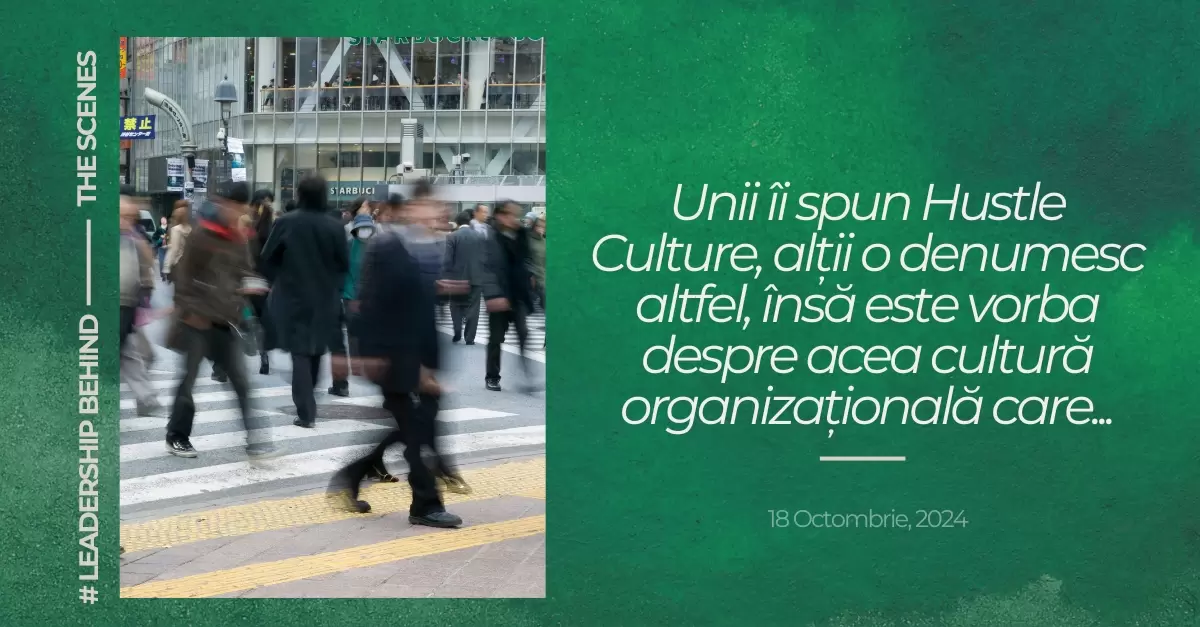
Some call this Hustle Culture, others give it some other name, but it describes the same organisational culture centred on constantly growing pressure and improved performance, leading to an ever-higher amount of work, which is, in its turn, justly appreciated and rewarded. It turns organisations into fine, shiny fruits, with nothing inside when cracked open.
Organisations based on this kind of culture consume people and their lives, which leads to high staff turnover. Some of these can be seen from afar: shining like falling stars, brightly but shortly.
This was what Hustle Culture looked like for me. I must admit I had let in take over me, that I had embraced it and felt its impact. It was too much. Days were too long, goals were too specific, and constant pressure slowly took its toll on us. Today I got to realise that real success will never come against balance and that performance can never be based on chronic perfectionism.
Today I no longer point out any unimportant error, although I still notice them as efficiently as I used to, I seldom punish anyone for an unintentional mistake and, strange as it may seem, I often take steps to relieve pressure off sales or the budget.
I mostly approve of my colleagues’ targets, although I sometimes think they are too hard on themselves. Some investors or banks may think this to sound bad, but we are about to double our turnover. I’m not saying there are no tensions, and I’m glad there are, because a lively, authentic organisation must be boiling, but not overflowing. We are currently analysing our organisational culture along with our partners at Ascendis (what a great company!) and this makes me nervous. We are bound to find some things are not right, but at least I’m sure that my people feel free. I want to make sure this goes for all of our 1600 colleagues, as, in such large cultures there is a risk of emerging subcultures, and I am determined to work with the others to get them where I stand from this point of view. And where I stand, there are neither boxes nor drawers.