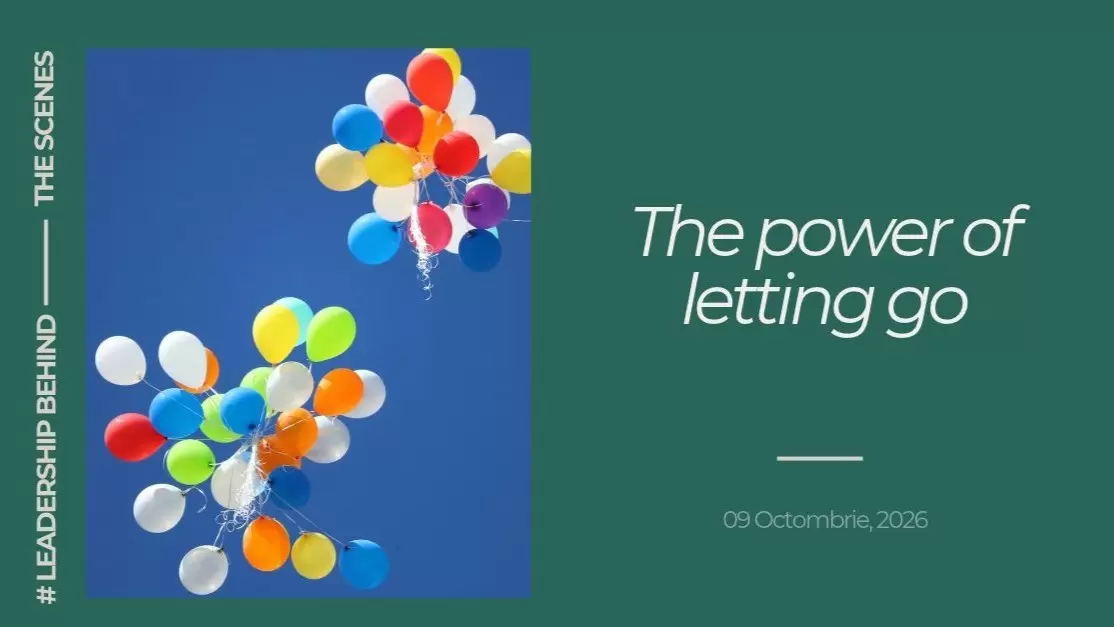
I’ll begin by apologizing to those reading the Romanian version for the English title. Unfortunately, the Romanian equivalent doesn't quite capture what I am trying to express.
There is a paradox in the art of exercising power, which might well be a reasonable definition of leadership: in its most mature form, it is about knowing when not to exercise power, or when to stop exercising it altogether. In this sense, leadership is not merely the art of wielding power, but also the art of understanding its limits.
I find it amusing how often certain aspects of human evolution bring to mind Nietzsche’s three metamorphoses of the spirit: the camel, the lion, and finally, the child. The camel bears the weight, accepts the burden, and learns endurance; the lion rebels, asserts its will, and wins the freedom to say “I will”; while the child, in what appears to be a regression, actually reaches the highest form of freedom, one in which it no longer needs to constantly prove its strength and can, once again, create.
Like many others, I too have gone through the stages of building things through my own efforts, of exercising careful control, and eventually of delegating and learning to trust. I believe there is an almost predictable biography of a leader here. At first, you do things yourself because there is no one else to do them. Then you continue doing them yourself because you believe no one else can do them quite well enough. Eventually, the organization begins to grow, and reality explains to you, with very little delicacy, that you can no longer be everywhere at once. So you learn to delegate, initially while constantly looking over the shoulder of the person you have delegated to, then with a little more ease, until, if things go well and your ego is willing to cooperate, you discover trust.
I now find myself moving towards the final stage of this maturation: the stage where I loosen my grip and let go.
This is not about abandonment or giving up. Rather, it emerges naturally after the stage of trust, without replacing it. You cannot truly let something go unless you have enough faith in people, in what you have built, and perhaps even in life itself, to accept that things can continue on their own course without your hand permanently resting upon them.
A legitimate question would be: what exactly do I mean when I speak of loosening my grip or letting go?
It may simply be a situation in which my opinion differs from that of others, or one in which a decision could be made by me, or just as well without me. It may be an activity I have carried out for a long time that someone else could now take over, perhaps differently, perhaps even better. It may be a project to which I have grown so attached that the investment I have made in it clouds my ability to judge whether it should continue at all. It may be a person, a position, a responsibility, or even a certain image of myself, once useful, but which time has slowly begun to empty of meaning.
A leader spends years in an environment that offers daily confirmation of their importance. They are called when a problem arises, summoned when things become complicated, asked for their opinion when others hesitate. Their approval opens doors, and sometimes a simple gesture on their part changes the course of an entire organization. All of this is perfectly natural; it comes with the responsibilities of the position. But it also has a side effect: after spending enough time at the center of this system, it becomes remarkably easy to start believing that the system needs its center more than it actually does.
It doesn't take a monstrous ego or some spectacular moral failing for this to happen. Sometimes, success alone is enough.
In fact, from this perspective, I find success far more dangerous than failure. Failure forces you to question yourself, raps you across the knuckles, and compels you to reconsider what you thought you knew about yourself. Success, on the other hand, supplies you with years of seemingly irrefutable evidence that your way of doing things is the right one. If you have intervened ten times and things have improved all ten times, it is almost natural to consider your intervention on the eleventh occasion not merely useful, but necessary. And slowly, without quite noticing when it happened, responsibility can turn into a dependence on control, while control can dress itself very elegantly in the garments of care.
“I have to get involved, because things still need me.”
Now, as I reread what I have written above, I find myself wondering whether it might convey a certain taste of weakness. But nothing could be further from the truth. I would argue that reaching this stage of maturity is an extraordinary luxury reserved for very few people. It represents, as the title suggests, a form of power, the highest expression of power.
I look around me today, both in the business world and, perhaps even more so, in politics, and I see how rarely people reach this stage of development in society at large. Of course, like any form of evolution, this too requires time, the right human qualities, and competence.
One could look at leaders through this lens and devise an indicator that places them somewhere along a continuum: from doing, to controlling, to delegating, to trusting, and finally, to letting go.
I believe this also has something to do with relinquishing the role of savior, a role we encounter so often in organizations and in politics. Leaders who present themselves as providential figures and who live by the deeply held conviction that the universe, society, or their organization has an existential need for their presence.
This is not a criticism. Leaders are raised to fight, to build, to persevere. But who teaches them to let go? Our culture admires them precisely for these qualities. We have entire libraries devoted to perseverance, resilience, ambition, and pushing beyond our limits, but surely far too little about limits themselves, about the responsibility to understand and accept our own. The society of “Yes, we can!” leaves no room for letting go, and this is both a false premise and something that runs counter to the universal laws of life.
This is not about helplessness, although helplessness, too, bears witness to countless examples throughout history. It is also about choice and power. The choice to leave enough space between yourself and the world for things to happen, and the power to deal with the consequences.
We live in a society that intoxicates us daily with the drug of power, of capability, of a life that seems endless, and of uninterrupted achievement. This exhausts us and pushes us beyond the borders of the land where our strengths were born. We are left depleted in a world that feels foreign to us, often estranged even from our own desires, vulnerable to burnout and depression.
We build so much over the course of a lifetime, and as this valuable edifice of relationships, experiences, and lessons learned takes shape, we grow ever more convinced that we own the entire process and must remain in control of it. And yet, there comes a moment when we must make the subtle distinction between perseverance and attachment. One entails action and control; the other, love and perhaps, sometimes, letting go.
And perhaps that is why letting go is so difficult.
It seems only yesterday that I was writing the previous article in this series at the beginning of summer, and now autumn is already upon us. Perhaps there is a faintly bittersweet taste, a shade of melancholy, in my thoughts. Perhaps autumn itself is nothing more than nature coming of age, letting go of its flowers and vivid colors, the exuberance and clamor of summer, and that faith in the beauty of tomorrow that feels so alive and present during the summer months, making way for the cold of winter, beneath which the explosion of a new spring is being quietly, surely, and powerfully plotted.