
At the forefront of Romania’s digital energy transformation, Corneliu Bodea, CEO of Adrem and President of the Romanian Energy Center, describes how the company has evolved from a traditional EPC contractor to an intelligent infrastructure integrator. In this conversation, he outlines Adrem’s shift toward automation, analytics, and flexibility — where batteries, sensors, and software work together to balance grids in real time. Speaking openly about regulation, insurance, and risks in the rapidly growing BESS sector, Bodea calls for a mindset shift: from building assets to building intelligence around them, from permission to encouragement, and from static infrastructure to adaptable, data-driven systems.
Adrem has positioned itself as a leader in automation, energy infrastructure, and smart system integration. What recent projects best illustrate this transition from traditional EPC work to data-driven, digital energy management?
We no longer see EPC as “the end of the project.” Real value now lies in how the infrastructure performs over time — how it responds, adapts, and learns.
Our most interesting work involves embedding automation, sensors, and analytics into the very DNA of the facility. For example, we’ve built control and monitoring systems that not only operate networks but also anticipate congestion, detect imbalances, and recommend dispatch strategies.
We are working to shift the focus from building assets to building intelligence around those assets.
As grid congestion and balancing needs grow in Romania, how is Adrem contributing to projects that integrate renewable assets with storage, smart metering, and network optimization tools?
Adrem is involved in hybridization projects where storage is no longer an accessory but a structural component of the grid. The next generation of networks will not just transport energy — they will negotiate it.
Our teams design control architectures where PV, BESS, and flexible loads communicate, share local balancing functions, and even participate in frequency response.
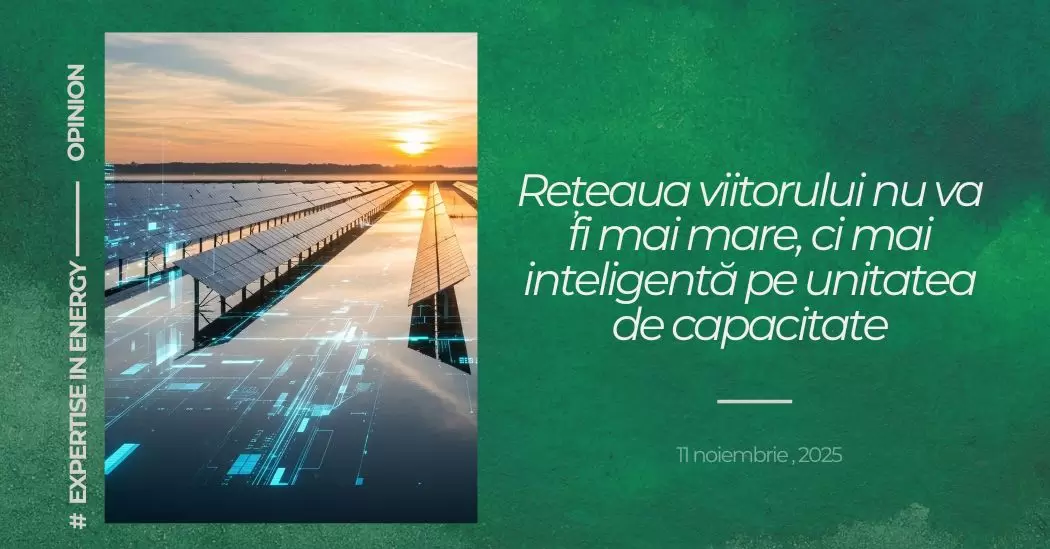
At the same time, our metering and SCADA operations provide the data necessary for real coordination. The grid of the future doesn’t need to be bigger; it needs to be smarter per unit of capacity — optimized through data, automation, and distributed flexibility.
You have long advocated for innovation in Romania’s energy ecosystem. From your perspective, what legislative or technological changes are most urgent right now to ensure industrial players can support decarbonization while remaining competitive?
We need to move from “permission” to encouragement. Regulations still view storage, flexibility, and distributed generation through the outdated “generation-transmission-consumption” lens. This model is obsolete.
We now need a framework where flexibility has a price, where network operators can ensure local balancing, and where investors know how to monetize storage.
The technology already exists; regulation must catch up. This requires courage — to simplify, standardize, and trust that the market can manage complexity if given the chance.
How aware are local developers and EPCs of the technical and operational risks specific to BESS projects in the early design and construction phases?
Awareness is growing, but understanding is still shallow. Everyone knows that “batteries can catch fire,” but few understand why — or how to prevent cascading failures through design and controls.
Thermal management, harmonics, EMC, grounding, and especially software security are often underestimated.
The lesson we try to share with clients is simple: BESS projects are control systems with attached hardware, not the other way around. Those who understand this early avoid most downstream problems.
How is insurance currently approached as a prerequisite for bankability, and what are the main gaps in understanding between developers, financiers, and insurers?
Insurance is too often treated as an administrative formality rather than engineering. Developers rely on generic policies; insurers lack technical data to assess risk; banks check the box and move on.
But batteries aren’t PV modules — they breathe, age, and respond to their environment. A credible risk assessment must correlate operational strategy (DoD, C-rate, temperature) with financial exposure.
Until engineers, financiers, and insurers speak the same technical language, we will continue to see mismatched expectations and overpriced premiums.
What challenges have you encountered when applying traditional insurance products to battery storage projects, and how could these be better aligned with the real risks of these projects?
Traditional products were designed for static assets — steel, concrete, transformers. Batteries are chemical and dynamic. The main challenge is that most policies exclude exactly what can happen: design flaws, degradation, and thermal propagation.
We need insurers who understand system engineering, not just actuarial tables.
A better model would tie insurance conditions to verified control quality: certified testing (UL 9540A, IEC 62933), cybersecurity audits, and emergency response readiness. Reward those who build safely, not just those who fill out forms!
How are co-located PV + BESS projects reshaping insurance needs, and how prepared are Romanian companies to assess and model this new risk profile?
Co-location changes everything. Risk no longer comes from “two assets side by side” but from a shared ecosystem — one EMS, one interconnection point, one operational logic.
Failures and losses propagate faster and wider. This means insurance must evolve from covering individual assets to covering the system.
Romanian developers are learning quickly, but standardized methods to model the combined behavior of PV + BESS are still lacking. This will be the next maturity test for our market.
What are the main siting and integration risks developers should anticipate when implementing BESS alongside generation assets?
Integration is where most projects fail — it’s not about chemistry, it’s about interfaces.
Electrical selectivity, protection coordination, fire safety, and clear separation between IT and OT systems — these are not “extras,” they are survival mechanisms.
The smarter the system, the smaller the margin for error. That’s why our approach is to design operational resilience first, performance second. A well-built system must continue to operate safely even when something — or someone — fails.