Taken from E-energia
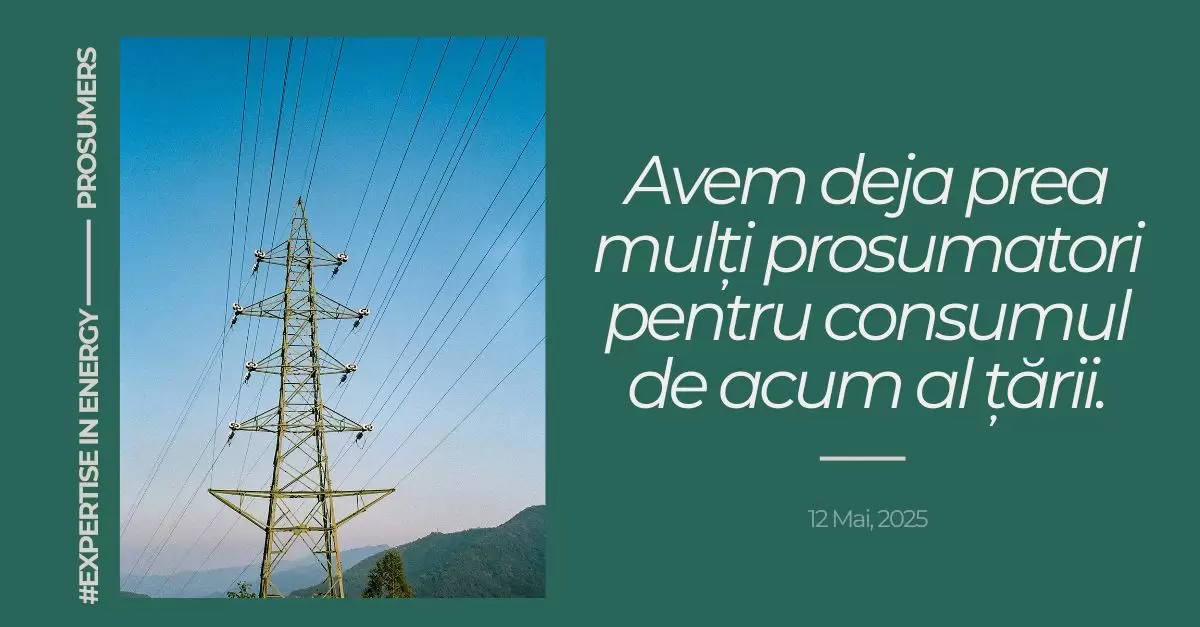
A few weeks after we recorded the lowest electricity consumption in Romania's recent history and immediately after the Spanish blackout, I interviewed Corneliu Bodea, founder of the Adrem Group and president of the Romanian Energy Center, with the topic of discussion being prosumers.
Some of the main statements, then the interview, in full:
- We are in a moment that is governed by unfair regulation and that sooner or later will turn against prosumers.
- Part of the benefit that prosumers have today is borne by other consumers
- Prosumers should receive the price, the value of energy, at the price when they produce.
- We are already well above what we should have had at this moment in terms of installed prosumer power at today's consumption in Romania. There is still room to grow, at the same time as consumption increases.
- There is no longer a need for this moment of "incentives", of encouraging investments in solutions for prosumers.
- Data centers, electrification of transportation, and electrification of heating will double current electricity consumption.
- We're going to have to invest in grids. We now see storage as a panacea, but storage solves a small part of the problem. A large part of the problem will have to be solved by consumption flexibility.
- Large-scale dynamic tariffs are absolutely necessary but are impossible because we don't have smart metering
- With the 600 million euros allocated for electrolyzers and hydrogen gas pipes that we didn't make, we could have installed smart meters throughout the country.
- The ultimate goal is to lower the cost of energy, not lower the grid tariff. The tariff can be low and the cost of energy high, or the tariff can be higher and lower the cost of energy.
Reporter: We are a week after Easter, when we had a historic minimum, if I remember correctly, somewhere around 2,400 or so megawatts instantaneously, and it was said before that the situation of the National Energy System could also be influenced by the behaviour of prosumers. That is precisely why there were those public calls to turn off the inverters. How much of the situation that was in the National Energy System at Easter, when we had this historic minimum consumption, is due to or how much of the situation was generated by the behaviour of prosumers in Romania?
Corneliu Bodea: Prosumers certainly played a role, meaning some of the consumption was self-consumption, and it's difficult to estimate now how much, and I wouldn't be able to estimate. I saw that the National Energy Dispatcher didn't give an estimate either. I can't say how much of this historical minimum is due to self-consumption, but it certainly was.
I can say something else. I can say that today we have, from my knowledge, over 2,500 megawatts installed in prosumers and we are heading towards 3,000 vertiginously. It is true that the latest Casa Verde Program (the Green House Program) also includes batteries, storage, which is finally a good thing. And there are at least 1,5 gigawatts, 1,500 megawatts, which are solar power plants in general, which are not prosumers, but which are non-dispatchable, so less than 5 megawatts.
In total, I believe we exceed 3,000 - 3,500 megawatts, prosumer plants or non-dispatchable production plants, this being a production component that is not under the immediate control of the National Energy Dispatcher and creates a risk. But in relation to the historical minimum recorded during Easter, it would probably have been higher with 1,000 megawatts that came from self-consumption.
Reporter: Could prosumers be a problem for the system today?
Corneliu Bodea: I wouldn't say they are a problem. I would say that the problem is related to the way we have understood to regulate this sector, that is, I would make a separation, a very clear distinction. One is the right of a man to install an energy production system intended mainly for self-consumption or the efficiency that he can acquire, and it is an obvious right, and another is the way in which those who regulate the system understand to make this possible. Here, we are in a moment that is governed by an incorrect regulation and that sooner or later will turn against the prosumers. But, for now, it is against the system.
Reporter: Explain a little why it is incorrect?
Corneliu Bodea: For several reasons! It’s easy to understand and perhaps the most relevant is related to the fact that today the energy supplier is obliged to take over this energy at a price that is not related to the price at the time they produce it.
Reporter: Should this change in legislation be imposed? I don't know if a law is needed from the Government, from the Ministry of Energy so that the prosumer be paid at the price at the time of injection, I don't know how they will continue with the quantitative compensation, the financial compensation... Basically, you are telling me that he gives it to the current supplier when it is on all roads, it is cheap, even negative, as sometimes happens, and he takes it from the grid at the peak of consumption, when the price is the highest. And the same with this financial compensation, he receives, the price he receives has nothing to do with the price he offers. Should this legislation be changed?
Corneliu Bodea: Certainly yes, because otherwise it is unfair towards the supplier. It is a phenomenon that goes like a snowball, it trains itself, because as I have more, as it is more profitable to install panels and become a prosumer, more and more prosumers will want to instal panels. They will generate an increasingly bigger problem, because we will have more and more energy produced during the day and especially around noon, when energy prices, for this reason, will be lower and lower. Or the right thing is for this phenomenon to have self-regulation, meaning that prosumers receive the price, the value of the energy, at the price of the moment they produce. And this is possible, so this should definitely be done. Then, there are other things in this list that are unfair. There is also the fact that prosumers inject, use the grid, but also take energy from the grid. When they take, they pay grid tariffs, when they inject, they do not pay the tariffs. They use the grid as a "buffer", as a means...
Reporter: But when they get their energy back, they pay.
Corneliu Bodea: Yes, they pay, but they should bear the grid fees and they should also be obliged to install storage. Because you determine in some areas of the grid to have the capacity to take over the entire energy that you can produce. You make it necessary to make additional investments, investments in grid reinforcement and so on, changes even to transformers, powers, etc. Installing storage should be mandatory for prosumers, because that's how you fulfil your role for which the prosumer exists, namely for self-consumption. So I produce, store and consume everything I have produced.
Reporter: It was a law, but you know how it is, in our country it swings to the maximum on one side and then to the maximum on the other, and storage was imposed, including retroactively, on those who had already installed panels. It was unfair…
Corneliu Bodea: It was unfair to force some people who made some calculations based on a law, even if they are private individuals. They made a calculation just like a company does: how much money do I have to pay to make this system, to recover it in a certain amount of time. And after the man made his calculation, you change the law. It is unfair. It should have been put in place from the beginning or from the moment this law came into force. When you make this change, you make it but never retroactively.
Reporter: So they should apply from now on only for the future.
Corneliu Bodea: It's definitely not right now to force everyone to install storage systems. That would be incorrect. You should have said that from the beginning.
Reporter: Well, now there are, as far as I know, 2,500 megawatts and 200,000 people. Where do you see this phenomenon going in 2030?
Corneliu Bodea: I will also answer in a hypothetical way, that is, where it would go if things remained the same: it would probably increase, double, triple. But it is hypothetical, because this is not possible. In my opinion, we are already well above what we should have had at this moment in terms of installed power of prosumers at today's consumption in Romania. If you ask me if there is still room to grow, yes, there is still room to grow, but there is room to grow at the same time as the increase in consumption. Where will this increase in consumption come from? I believe there will be a substantial increase in electricity consumption, mainly from two sources.
One is represented by data centers, because today, if I'm not mistaken, any image generated with artificial intelligence consumes 0.2 kWh. Now, think about the fact that we're talking about children who now make kittens on AI and all kinds of other images or everyone creates videos, not just images. Any query on AI consumes energy. I think this will grow spectacularly, just like social media has grown. So there will be a phenomenon like this, and together with social media there will be an explosion in the use of artificial intelligence, which will entail a need for power to generate and support this data traffic and maintain the data.
Then there are electric vehicles. Notice that China recently announced a one MWh miracle battery. You can see what this means. I'm talking about both one phenomenon and the other. They are extremely important, because they come from human demand. I mean, it's not a phenomenon that comes from something imposed, like, "sir, let's give up on gas, let's switch to electricity, heat pumps." As long as it's not efficient and people don't want to do this, you can impose regulations on top of regulations and we've seen that things fail to spread, but here it comes from human demand.
The man will ask for a car, he will want to have an electric car. He will put pressure on the government, on politicians, on everyone to give him the necessary conditions so that he too can go 1,600 km with 100 lei or 200 lei, instead of going with 1,000 lei for the same distance. This is an obvious thing that will happen and then the network will have to give him this possibility.
Well, the "bottleneck" here will come in the grids, not in capacity, but we will have to install more and more sources. And then of course the percentage of prosumers will also increase with the increase in consumption. That is, if Romania today has 2,500 megawatts installed at prosumers, at a consumption of 7,000, when it reaches consuming 10,000 it could have 3,500-4,000. This would be a reason for growth.
The second reason for growth will come when we understand how to invest in grid intelligence, in "demand response" solutions, in balancing solutions based on flexibility, both in production and consumption.
At that point, this area of intermittent production, not baseload production but which is cheap, will be able to grow. Otherwise, as the consumption model is today – we don't have dynamic prices, we don't have smart meters, we don't have enough grid flexibility and storage – we are limited to the development of prosumers.
What will they do? ANRE will come and change the legislation and say that the price is no longer the average one on PZU (day-ahead price), that it is the price recorded at that time or the average price recorded at that time. Then, they will say that I can no longer install without storage. The state support programs will probably stop.
Reporter: That's what I wanted to ask you: do you think there's a need to continue this type of subsidisation now?
Corneliu Bodea: In order not to criticize it from the beginning (the AFM program), the fact that they introduced batteries - although it is the third or fourth program in this sequence, that is, it is very late, they should have done it from the first program - is a good thing. In my opinion, there is no longer a need for this moment of "incentives", of encouraging investments in solutions for prosumers. We have reached a level where those who really want, for serious reasons, to become prosumers - the fact that they are concerned about global warming, the fact that they want to make their contribution to the fight against climate change, the fact that they want increased efficiency, security in the continuity of supply - at this moment, at the cost of the panels, it is profitable to make the investment without state support. So, in my opinion, the money at this moment should rather be spent elsewhere, if we still have it, than in stimulating the development of new programs for prosumers.
Reporter: Where? In grids?
Corneliu Bodea: In the grids, first of all, because this is the crisis we are in now. A huge crisis, a crisis that can turn into a catastrophe like the one in Spain today or, well, others, because we will no longer be able to manage it.
And I have a big question mark about the feasibility of many renewable energy projects that are being developed right now. Large projects, medium and small projects?, because we reach a production capacity that exceeds consumption in certain time intervals and then they will not be able to produce all, on the one hand. On the other hand, it is obvious that we have several major plants, which cannot be stopped and it makes no sense to stop them. Such as the Danube. Any time that Iron Gates 1 and 2 are not working, there is a huge amount of wasted energy, because the Danube flows anyway even if the water passes through the turbines or not. There are also the nuclear projects 1 and 2, in which we are investing billions of euros to extend their lifespan.
Reporter: And we're still investing about 10 billion for reactors 3 and 4. Are they still feasible under these conditions?
Corneliu Bodea: That's a very good question...
Reporter: Speaking of flexibility, reactors run as baseload, meaning if they don't find a direct consumer, is it worth investing in them to produce, I don't know, a few hundred hours a year at a negative price?
Corneliu Bodea: It's a very good question and now I don't have an answer for this question, because really, to calculate the feasibility of the reactor projects 3 and 4, we should have some very serious forecasts related to consumption at the time when these projects are achieved. Because in order to achieve a nuclear project 3, let's say, we need 10 years from now on. So any term more optimistic than 10 years...
Reporter: They said 2032.
Corneliu Bodea: No, no, we said 2032. Iernutul… we are in 2025. It started in 2015, if I'm not mistaken, maybe I'm wrong, but I know it's been 10 years, there were some specific things there… I'm not saying that all projects will be like that, but in my opinion, a nuclear project, today, in order to be able to achieve it, from the phase we are at right now, we need 10 years from now on. So I would rather say 2035. The Romanian state has to make a strategic decision and it may be that – and I agree with this – they are feasible, they are not feasible, we do them, but we don't know how much energy we will consume. If you ask me, I am optimistic. I think, as I said earlier, that from three sources, I have already mentioned two: data centers, the electrification of transport and then the electrification of heating.
From these three sources, we can at least double current consumption and then yes, reactors 3 and 4 are also possible. I believe in this balance in Romania between hydro, nuclear and renewable resources, but all of these go through the grids.
You see, there is an erroneous discussion at the moment in Romania, which says Romania consumed 11,000 megawatts during communism and how can we say today that the grids are not good when we consume 6,000, 6,500, 7,000 megawatts?
Well, yes, but we consume in the first place through other grids and, yes, we could say that we have a transport infrastructure that was able to carry this consumption, but the consumption was centralized, localized. We had large industrial centers that consumed over 60-70% of this consumption, we had dedicated lines - we have them now, unfortunately, we no longer have the consumers. We had dedicated lines that took the energy from point A and carried it to point B. Today, if we have 10,000 megawatts, we no longer have the same lines. We have an increasingly large flow, which is carried out in 110 lines, in 20 kilovolt lines. We have all the small renewable projects, which are connected even in medium voltage lines.
So we have the urban, major developments, which consume most of that, let's say 10,000 - 11,000 megawatts, where we will be in the next 5-10 years, but we are talking about other lines, the old ones were never designed to do something like that. Never! And then we will have to invest extremely much in low voltage, medium voltage, in the 110 kilovolts part and in a rethinking and redesign. So the idea that the system worked at over 11,000 megawatts and will have to work now on the new model of production and consumption does not work, they will not be able to work.
So we'll have to invest in grids. Now we see storage as a panacea, but storage solves a small part of the problem. A big part of the problem will have to be solved by the flexibility of consumption, because even if we invest in, let’s say, 6,000 megawatts of renewables and install 6,000 megawatts of storage, it still doesn't help us enough. Sure, it would be better, but it would be 6,000 MW for an hour.
Reporter: Transelectrica said that even 4 hours of storage might not be enough.
Corneliu Bodea: Yes, if you install a four-hour storage system, then it will be four times larger than the unit that produces it behind you to be equivalent to it. It is a good thing that now, here, we have a lot of projects on storage, we have space, but it will not solve the whole problem. We will have to invest in grids to make them smart, capable of taking the energy where we will need it, that is, to the charging station of other electric vehicles, to the heat pump that will replace the gas heating installation, to the data center, which will be the new big consumer of electricity, instead of the factory and the plant. We will have to take the energy there and we will need to have smart metering. Denmark has moved 12% of consumption to the peak, and 12% is enormous, only by the fact that it set a differentiated tariff between six and eight in the evening. 25% higher than the rest of the day.
Reporter: Do you think dynamic tariffs will appear on a generalized level now, after the cap is lifted?
Corneliu Bodea: Well, they can't appear because we don't have smart metering, how would I know how much energy that person consumed?
Reporter: At least where are smart meters? Where we have a quarter…
Corneliu Bodea: You can't set a dynamic tariff for one and not for another. The other person will come and say: Why don't I have the same tariff? It's not his job to install the meter, it's the distributors' job. In order to install meters, distributors must obtain a tariff from ANRE and make investments. This tariff goes back to the consumer and in this way the consumer...
Now, I ask the question: instead of putting or proposing to put 600 million euros into electrolyzers and hydrogen gas pipes that we didn't build – and it's lost money because the Commission cut us off from this money – wouldn't it have been better to put smart meters all over the country for 600 million?! With 600 million we would have installed smart meters all over the country. It's a proposal that several of us made at the time.
Now I looked, the Prosumers' Association is very active, I admire them, but they also serve their own interests. They need to understand one thing: they are arguing in vain with the operators of the grids, because grid operators, in order to serve the interests of prosumers, must invest. In order to invest, they must have investments recognized by ANRE. This tariff goes back to all consumers, because ANRE cannot let the tariff increase either, it is a matter of affordability.
Reporter: They will be upset when they understand that in fact, what is an advantage for them is borne by the other consumers in the grid.
Corneliu Bodea: This is something that everyone needs to understand, that right now prosumers are benefiting, yes, from a cost that is shared with others, who are not prosumers. That is, basically part of the benefit that prosumers have today is borne by other consumers who are not prosumers. And this is something that we all need to understand.
So investments in grids, flexibility, storage and offering advantageous conditions for electrification, that is, for increasing consumption. If we do not increase consumption in Romania, we will continue to be left with underdeveloped grids, with high energy costs, with the inability to manage strange flows of production. We will have to increase consumption. In order to increase consumption, we must offer the possibility through grids to those who will bring this increase in consumption. But this should be a policy, a strategy and this will also lead to continue investments and to a continued increase in the number of prosumers, because we are making room for them. If we increase consumption, we can. As we consume now, we have too many prosumers.
Reporter: There was another discussion about how much the grid can influence the prosumer's behaviour? I mean, should the grid somehow have some kind of dynamic control over the inverter and should the prosumer agree to this, should he be forced to agree to this, should he be "incentivized" to agree to this, etc.? Because there was another discussion like "you want to produce, you feed into the grid, you all feed into the grid, the voltage rises above 253 volts, you all disconnect, so no one produces anymore". Allow me, the grid operator, to have control over your inverter and it will work at the same pace as the grid. Ok, you won't inject 10 kW anymore. If you have 10 "peak", you'll probably inject three or four at certain times, but you don't stop... How do you see this?
Corneliu Bodea: It is obvious that this should be the right thing to do. That is, the grid operator, the distribution operator in that area should be able to have control over the inverter.
The question is, are they ready to do this? I mean, if tomorrow someone said to them, “yes, here you go, take control over my inverter,” would they be able to do so? Probably not, because they would have to make some investments too. It's about SCADA systems, to have this control in an automated, smart way.
But it is obvious that this would be logical. Exactly as you have noticed. That is, today it stops everyone when they draw too much from the grid and increases the voltage, instead of regulating production in such a way that they can produce less, so as to maintain a voltage balance. Moreover, we must understand something that is not correctly understood. The main philosophy of the prosumer is the idea of producing so that you can consume. This is connected to the idea of storage – if you do not consume exactly when you produce, you must also store. That is your job. The idea of injecting energy in the grid is an additional benefit, it should not be a granted right and taken for granted. Being a prosumer must be a measure to streamline your costs, it is not a method of making money.
What are we doing now? Prosumers? We are all becoming energy producers. We are energy producers in every home. Leaving aside the fact that there are a lot of projects that far exceed the power (there are situations in which we have approval to install five kilowatts and there are 100 kilowatts, but there are exceptions and this is slowly being solved), it is obvious that distribution operators should have control over the inverter, as long as you are connected to the grid and you are feeding into the grid. When you are "behind-the-meter", you manage your battery, no one should have control there. But when you need the grid, the operator should be able to have control over your inverter.
Reporter: Do you think this idea of energy communities would be more cost-effective for some communities and would also allow prosumers to develop further, or is it just "let's just say that others have done it"?
Corneliu Bodea: No, it's a very good idea. Obviously we have to do it through the grid and that's a very good idea, which also helps the grid. Why? The energy community should not be seen as us gathering more people to produce more, to inject more into the grid. It's because today I produce, another consumes, because I produce more than I consume and another can also produce, but has a lower production, because that's the geometry of the roof, because that's the place where he installed his panel. So the idea is to produce and consume as localized as possible, that's how I see it.
Reporter: And can the grid handle this problem too?
Corneliu Bodea: In principle, the grid operator can take care of this. Now again we start from smart metering. Sure, where we have prosumers, in general, we have smart meters with GPRS transmission, but I can also have consumers in this energy community, not only producers, I have producers and consumers. The consumer must also have a smart meter installed so that I can know in certain intervals as it is now the 15-minute, how much his consumption was, so that I can see that he consumed in that community while someone else produced in the same community. So we get to the same point: to the huge investments that need to be made in the grid. That is, all distribution operators, in order to manage such systems, will have to invest an extremely large amount of money in smart metering, in management systems and remote control of these management systems, of these reporting systems, which requires investments and time.
Reporter: How to solve this eternal dilemma? The grid needs money to develop. The money comes from our tariffs. From the distribution tariffs, paid by everyone. ANRE says it cannot accept very large investments, because it increases the tariff too much. Distributors say “you give us this much, we do this much, but it is not enough”. How should the situation be solved? Or, let's say, how should this Gordian knot be cut?
Corneliu Bodea: Everyone is right here, but everyone has something to do. ANRE is right to look with concern and wants to make sure that the energy tariff does not explode. It is ultimately its purpose or one of the main purposes for which this structure was created, along with maintaining the grids in good working order. So they are right to look with concern and make sure that investments are directed where they bring efficiency.
On the other hand, distributors are required to invest a certain minimum and want to invest more and more to increase their regulated asset base and increase their future revenues.
ANRE has the role – and has done so recently – to maintain a very active dialogue with distributors to understand that the ultimate goal is to lower the cost of energy, not lower the tariff. The tariff can be low and the cost of energy high, or the tariff can be higher and cause the cost of energy to decrease.
And I'll explain how: through smart investments in infrastructure and energy transport and distribution, especially in the distribution infrastructure now, because it's the "hottest", we can ensure a much better management of this renewable energy capacity that is very cheap. We could achieve flexibility in consumption so that people consume at times when energy is cheap. Also through investments in the grid, and I gave an example, the clearest one: the smart meter. If I don't have a smart meter, I can't give the people a tariff to consume at night or at noon (when it's cheap – editor’s note) instead of at 7:00 p.m. I would achieve a decrease in the consumer's cost of energy, but the tariff increases, because these investments will have to be recovered in the tariff.
So this is what ANRE must do: understand this, maintain dialogue with distribution and transmission operators to direct their investments where the tariff increases, but the total cost of energy for the family, respectively of the consumer, decreases.
Distributors, on the other hand, have to explain and model very clearly to ANRE. It is their duty to show them how, by increasing investments, the consumer's energy cost will decrease. So they have to show: "look, if I invest this amount of money here and if you give me a higher regulated rate of return and I can make a bigger investment, I will generate a decrease in cost."
And these things can be done. They are not contradictory. We are now in an equation, in a "lose-lose", in a zero-sum game, so to speak. I mean, sir, we are not investing so that the tariff does not increase too much and by not investing, we keep the total cost of energy high, because we cannot use the energy within a day.
If we look today, anytime, on any day, we have energy from a price of minus or 10-20 lei/MWh to 800 -1,000 lei, within a single day. Of course, I can't take all the consumption there, but I take part of it to areas where the price is lower. Of course, the more I take the consumption to those parts of the day, the more that price is not so low. This is one of the absolutely necessary measures in order to manage this volume of prosumers. This volume of renewable solutions, even the large ones, bring the same problem, even greater than prosumers. When you have thousands of megawatts in solar plants at noon, the energy price will be negative and I don't know how they will recover the money, because it will be negative. The more projects we do, in the middle of the day, when they produce, the price will be negative.
Reporter: And tomorrow it will be negative. It is the second day in a row that it is negative.
Corneliu Bodea: Yes. It is normal to be like this given that we are not doing anything, neither in terms of regulation nor in terms of investments in the grid. That is, once again, we must ensure dynamic tariffs.
If we don't provide dynamic pricing, people will not be encouraged to consume responsibly. What difference does it make to me today when I go home if I turn on the dishwasher at 6:00 P.M. or if I turn it on when I go to bed? None. How many of us think: wait, I got home, there were those dishes, wait, I'll put them on when I go to bed. Everyone gets home, everything turns on. The refrigerator starts to consume more. I open it, I close it, I open it, I close it. I turn on the washing machine, the dryer, all these things. So dynamic pricing is needed.
Summer is coming now, the air conditioning… You don't keep it on all the time, right? You leave in the morning, you turn it off. You're not home, the apartment gets very hot, and it becomes like a furnace. When I come home in the evening, I turn it on to maximum, because I want to be cool inside in the evening.
I should have kept it on all day and when I come in the evening, to find 20 or so degrees, and then it gets cooler outside and I turn it off. The air has practically consumed energy at a low or even negative price. But if it takes my money at the same tariff, it doesn't matter when I turn it on.
Do you realize what that means, how many millions of air conditioners would work differently? How much does that mean? It means a lot and certainly that price would no longer be negative. It would also support those who have invested in renewables and we would balance it out that way. But for that to happen, we need something simple: to be able to bill for a short period of time – let's say 15 minutes, let's say an hour – to know exactly how much that person consumed in a certain period of time. Today, we read a meter every three months and we can’t know how energy a person consumed in a certain period of time.
Courage is not the opposite of fear. It is the daily exercise of not giving in to it.
I feel it hitting my stomach first, hard at first, suddenly, like a cramp! Then its volume drops like the music at a wedding when cabbage rolls are served, it remains there insinuated and covering. My mind starts rolling it back and forth and giving it shape, first outline, then structure and, finally, colour. I have a simple colour palette: red, brown or yellow. Colours that remind me of bad things…
It generally appears in the evening or at night and dissipates the next morning, but it can also appear during the day and return between 3 and 4 in the morning, when you realize that, staring at the ceiling, you can't get rid of it and you get up to do something, anything. Read, watch an episode, or patrol the house.
It appears as a stupid idea or a piece of news, a piece of information. Once it has penetrated you, it dissipates within you, starting as a thin thread in suspension, which multiplies and gradually encompasses more and more fibers, cells. You try to reject it, and in this way you multiply it and give it consistency. Any thought sent to fight it is converted into another stupid idea that multiplies and conquers you. Now, if you look more closely, you find a complex web of consequences, like the back of an old tapestry.