
I had been looking forward to summer for weeks, and now that it has finally arrived, it reminds me that nothing comes with only upsides. That feeling when you've just stepped out of the shower, but ten minutes after putting on your shirt you already need another one. I find that deeply irritating.
Anyway, I was scheduled to be the first speaker on stage that day.
It's always difficult to go first. There is pressure, a collective expectation hanging in the air. You set the tone for the entire conference. The room felt lifeless, the audience drained by the heat, boredom floating around like a haze spread unnaturally evenly across the hall. A few half-hearted rounds of applause at the mention of my name signaled that it was time to step up.
I have my techniques. I know how to energize myself, and I know what to tell myself when the moment calls for it.
Then, somewhere between the three steps leading to the stage, a parasitic thought struck me - perfectly timed, the way salt finds an open wound:
How disastrous would I have to be to change the audience's perception of me?
I parked the thought, finished my brief ascent, and began. How I had been up to that moment no longer mattered. There was something else I wanted to talk about.
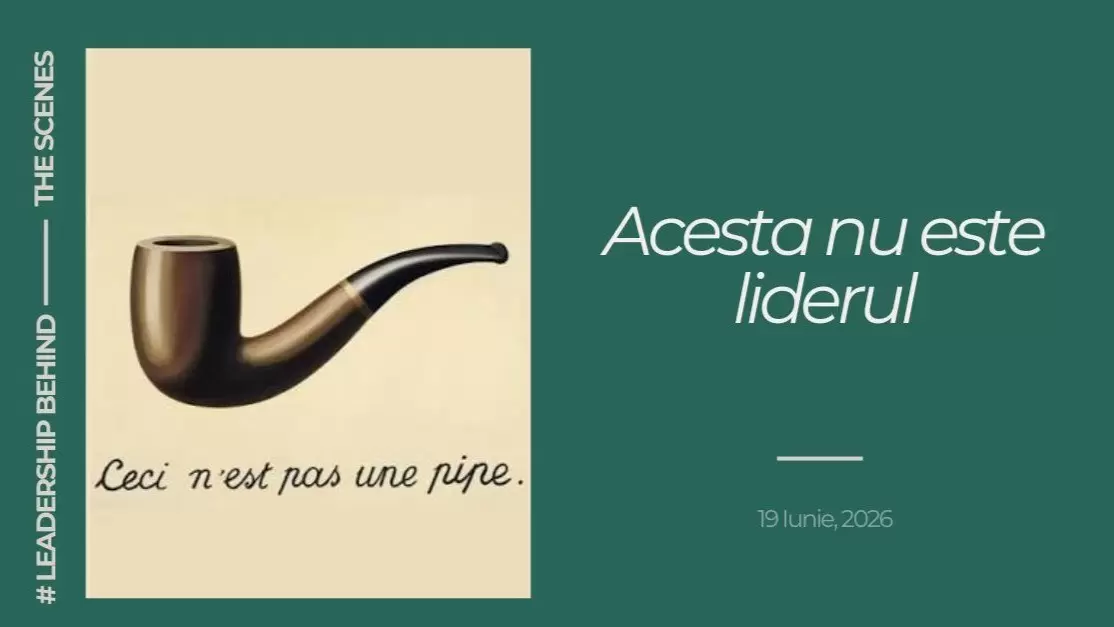
Leaders of every kind eventually become acquainted with an external image of themselves - one that is constructed, with varying degrees of care, by themselves and their advisers, but also by others. Such an image emerges through a complex process. It is shaped by facts, achievements, and publicly stated positions, but also - often more artificially - by what others say or believe about them, by countless interpretations of actions, whether real or merely presumed.
Naturally, this image evolves over time, pressured and reshaped by all these forces. At times it may be favorable; at others, less so. Occasionally it may become disastrous, while at other moments it appears exceptional - always within certain proportions and over appropriate stretches of time.
More commonly, however, our image is viewed positively by some and negatively by others at the very same moment. In other words, we can be deeply admired by one group and profoundly disliked by another.
This is one of the more difficult realities of leadership.
The reason is simple: most leaders - perhaps with the exception of those whose emotional intelligence is severely underdeveloped, and unfortunately we seem to have no shortage of such examples lately - are deeply influenced by how others perceive them.
More than that, in the pursuit of maintaining a favorable public image, leaders naturally begin to adjust their actions according to what is expected of them - or what they believe is expected of them.
And this raises an important question: Who is that person, really? What is their inner image of themselves? At what point does adapting to expectations transform us into someone else entirely?
How do we preserve a thread running through our lives, a guiding line capable of leading us through darkness toward our authentic destination?
How do we preserve our strength and cultivate the energy required to endure those periods when we are neither liked nor understood?
Søren Kierkegaard identified the greatest danger a person can face as this: to die before becoming who one truly is.
We live out a role. We construct what Carl Jung called a persona. How deeply do we come to identify with it? How much is it shaped by the reactions we receive along the way? Who are we, really?
I believe each of us carries two biographies. One is external, built from the positions we hold, the visible results we achieve, the recognition we receive. The other is internal, shaped by the values we believe in, the compromises we refuse to make, and the meaning we assign to our experiences. One of these biographies is visible. The other is not.
Both contribute to our public image, but only one truly belongs to us in the same way a home port belongs to a sailor. A sailor may set out for countless destinations, but only one harbor is home.
Václav Havel once observed that freedom begins where imposed roles end. And yet one of the hidden consequences of leadership is precisely the temptation to act in accordance with one's public image.
To live according to the expectations of the press, shareholders, colleagues, or followers is a subtle but very real form of captivity.
I believe it is essential for a leader to possess an inner universe an identity of their own and, more importantly, to be aware of it.
They need a private space of meaning.
Whatever name we choose to give it, this identity must first be discovered and then accepted. This is why I have repeatedly written about the importance of self-knowledge and the need to pursue it through whatever means prove effective.
I believe Marcus Aurelius referred to this as the "inner citadel." I have always liked that expression because it implies defensive walls and acknowledges the reality of siege.
This inner citadel is constantly under attack - often by the armies of our public image, or by the expectations that others project onto us. The stones of its walls are our values, and the mortar that binds them together is character.
In a society where images are crafted on social media using increasingly sophisticated tools, where everyone seems determined to appear as something they are not, how do we preserve authenticity in leadership?
In a world where falsehood dresses itself so convincingly in the garments of truth, where we speak of a post-truth era, how do we continue to recognize and reward what is authentic?
How do we educate future generations of leaders to discover and preserve their inner identity, and to strengthen the walls of their own inner citadels?
Perhaps through the example we are still able to offer.
I wish you a wonderful summer.