

Q: Besides the heatwaves, what is the reason behind Romania’s record hourly prices during the day on the day-ahead market in the evening peak consumption times?
A: Like any market based on the supply and demand principle, the price rises when the goods are scarce. High demand caused by excessively high temperatures and evening consumption, in combination with decreased production because of halting photovoltaics and the lack of wind is forcing Romania to import energy at high prices. This is worsened also by the regional context, where energy generation is deficient, and the interconnection capacity lower than in the Western part of the continent.
We can see that, for a few weeks now, the south-eastern part of Europe has been recording spot prices that are much higher than the average levels on the Central and Western European markets. Why would that be? Can we suspect a dysfunctionality in the day-ahead market coupling mechanism through flows that are detrimental to our country?
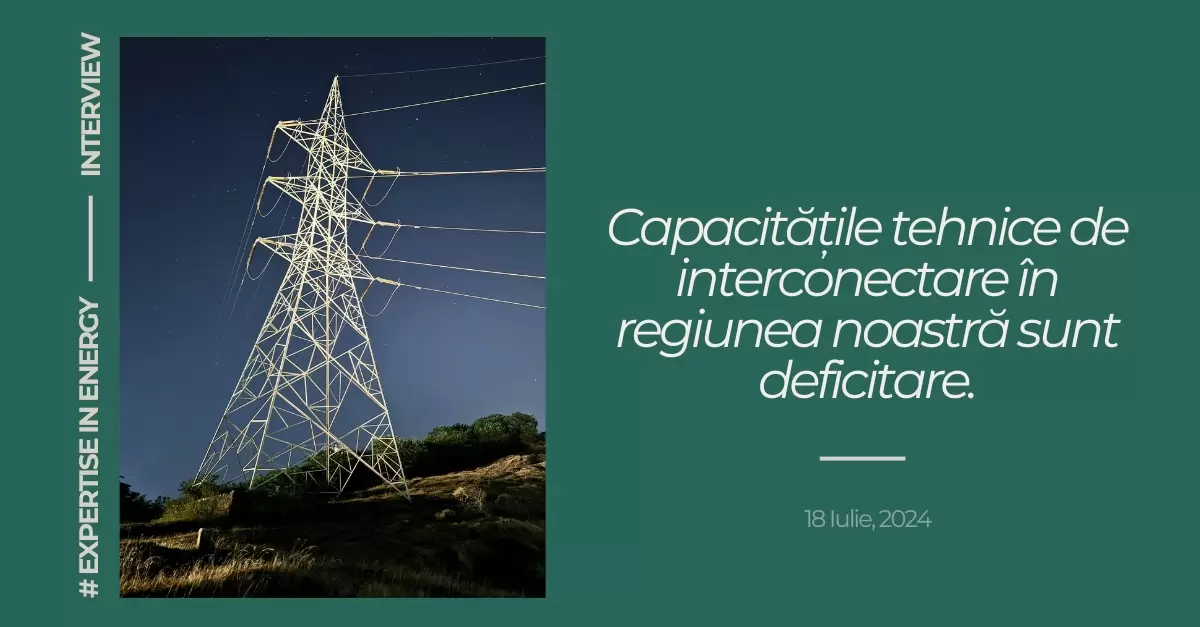
A: Technical interconnection capacities in our region are deficient. I do not think there are dysfunctionalities concerning market coupling, but rather dysfunctionalities concerning a regional production structure, which is more vulnerable to volatility.
Besides the day-ahead market price, for several months now we’ve had extremely high prices (we’ve even had RON 16,000/MWh on the balancing market). Why do you think this situation occurred and how can things be adjusted?
A: In the absence of consistent investments in increasing transport and distribution infrastructure flexibility, which could be ensured by storage and smart grid systems alike, demand side management or demand response, balancing shall be inefficient, and quantities on this market shall put pressure on the supply.
The digitalisation of the Romanian energy system is essential to the monitoring and optimisation of energy consumption through smart metering and smart grid. It is equally important to create an online platform where consumers can access detailed information on their energy consumption, on costs and their options for saving. This will be a tool that will contribute to increased transparency and to rendering consumers responsible.
At the same time however, we need to remember that ANRE (the Romanian Energy Regulatory Authority) has discouraged and neglected investments in information systems specific to smart grids, but also in smart metering. We are currently and unfortunately reaping the fruit of a deficient culture of investment regulation. I hope the new regulatory period brings about urgent changes to this approach.
Finally, how do you think energy suppliers shall be impacted by these developments on the two markets – the day-ahead market and the balancing market?
A: At a time when prices are chapped, suppliers will be the first ones impacted because they will need to collect huge amounts of money as compensation from the state, which means greater financial exposure.
What prices should household and commercial clients expect starting 1 April 2025 in the context of re-liberalisation considering the latest market developments?
A: I have repeatedly said that there is no reason for prices to drop between the EUR 80-100 per MWh range in the medium term, which is significantly greater than the capped prices of today. In order to have a drop in the EUR 50-60 MWh range, we will need to invest in generation for now, and particularly in growing the T&D infrastructure, as mentioned before, through investments in smart grids, in storage, in demand response, the automation of grids and infrastructure cybersecurity.
Given the current generation and consumption conditions in Romania, should the OPCOM (the Romanian Electricity and Gas Market Operator rethink transacting products, meaning that now, on the bilateral contract markets only baseload, off-peak and day-peak products can generally be supplied?
A: In order to provide markets with the possibility to diversify products, we need smart metering and measurement data management systems. Without investing in infrastructure, product diversification capacity is limited.